
Top 20 AI Automation Ideas for Small Businesses: High-Demand Opportunities for the Next 10 Years (2027–2036)
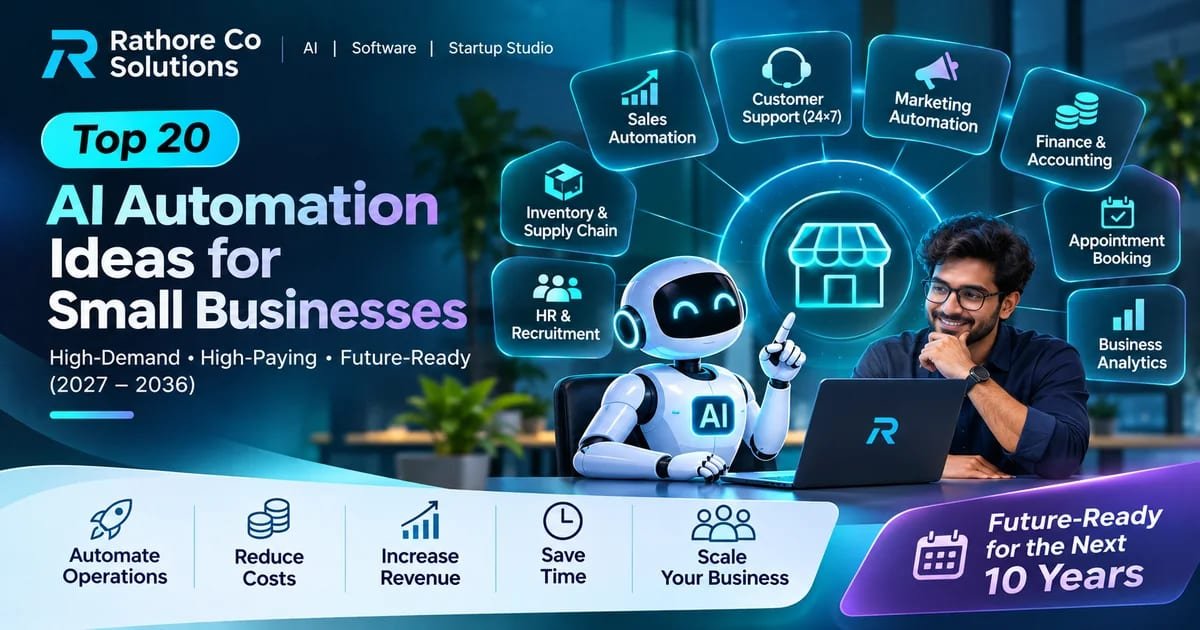
Twenty AI automation opportunities a small business can buy or an agency can build — customer support, sales, accounting, inventory, documents, security and more — with the industries that need each one, how they are charged for, and what the next decade may ask of them.
The next generation of successful businesses will not necessarily have the biggest teams. They will have the smartest systems.
Imagine running a business where customers receive instant responses, sales leads are followed up automatically, invoices are processed using AI, marketing campaigns run with minimal manual effort, and business operations continue even when the owner is sleeping.
This is the opportunity created by Artificial Intelligence and business automation.
AI is no longer limited to large technology companies. Small businesses, startups, agencies, retailers, manufacturers, hotels, and professional service providers can now use AI-powered systems to improve productivity, reduce repetitive work, and compete more effectively.
But the biggest opportunity is not simply using AI to write emails or generate social media posts.
It is building intelligent business systems that solve expensive operational problems.
For entrepreneurs, software developers, technology consultants, and AI automation agencies, this creates opportunities to develop valuable products and services that businesses need today and may continue investing in throughout the next decade.
In this guide, we explore 20 AI automation ideas for small businesses, including their business applications, commercial opportunities, target industries, and potential for the next 10 years.
Whether you want to automate your own company, start an AI automation agency, or build a profitable AI-powered software business, these ideas can help you identify your next opportunity.
Why AI Automation Will Become a Major Business Opportunity
Small businesses face several common challenges:
- Limited employees and operational resources.
- Increasing customer expectations.
- High customer acquisition costs.
- Repetitive administrative work.
- Delayed customer responses.
- Disconnected business software.
- Difficulty managing large volumes of information.
- Increasing competition.
AI automation can help solve these problems by combining artificial intelligence, software integrations, business workflows, and intelligent agents.
Recent research demonstrates that this opportunity is already developing.
According to the Federal Reserve's 2026 Report on Employer Firms, which reports the findings of the 2025 Small Business Credit Survey, 46% of surveyed firms said that their business or its employees currently use AI. Among those AI users, 71% reported improved productivity, while 31% reported higher sales.
The OECD's Empowering SMEs in the Age of AI (February 2026) finds the same direction of travel among small and medium-sized enterprises, with businesses moving past general-purpose tools towards more customized applications and AI agents.
These findings suggest an important shift: businesses are moving beyond experimenting with AI tools and are beginning to explore how AI can become part of their everyday operations.
The 20 Best AI Automation Ideas for Small Businesses
The following opportunities are selected based on business value, recurring operational needs, potential for software integration, and opportunities for specialized implementation services.
The commercial potential rankings below are strategic assessments, not guaranteed market returns or verified industry salary data.
1. AI Customer Support & 24/7 Virtual Receptionist
Commercial potential: Very high
The problem:
Small businesses lose potential customers because they cannot answer every call, website inquiry, WhatsApp message, and email immediately.
Hiring customer support employees for every shift can be expensive.
The AI automation solution:
Build an AI-powered customer support system that communicates with customers 24/7.
It can:
- Answer customer questions.
- Respond to website inquiries.
- Handle WhatsApp conversations.
- Provide product and service information.
- Collect customer details.
- Create support tickets.
- Schedule appointments.
- Transfer complex queries to human employees.
Industries that need it:
Hotels, hospitals, clinics, real estate companies, e-commerce stores, educational institutes, and professional service businesses.
How to monetize:
Charge an implementation fee and a monthly management subscription. Additional charges can apply for conversation volume, integrations, and advanced workflows.
Next 10-year opportunity:
AI receptionists may become a standard part of business communication, evolving from simple chatbots into voice-enabled agents capable of handling more complete customer journeys.
2. AI Sales Agent & Lead Qualification Automation
Commercial potential: Very high
The problem:
Businesses generate leads through websites, advertisements, IndiaMART, social media, and referrals. However, many leads are lost because sales teams respond late or forget follow-ups.
The AI automation solution:
Create an AI sales agent that works with the company's CRM.
It can:
- Capture leads from different channels.
- Understand customer requirements.
- Ask qualifying questions.
- Categorize leads by priority.
- Send personalized follow-ups.
- Schedule sales meetings.
- Update CRM records.
- Notify sales representatives about high-value opportunities.
Industries that need it:
Real estate, software companies, manufacturers, education, insurance, hospitality, and B2B service providers.
How to monetize:
Sell AI sales automation as a complete implementation package, followed by monthly subscriptions and CRM integration services.
Next 10-year opportunity:
AI sales systems will increasingly coordinate customer conversations across multiple channels, recommend next actions, and assist human salespeople throughout the sales cycle.
3. AI Marketing Automation & Content Operations
Commercial potential: Very high
The problem:
Small businesses need consistent marketing but often cannot afford separate teams for content, SEO, social media, advertising, and analytics.
The AI automation solution:
Build an AI-powered marketing operations system.
It can:
- Research content topics.
- Generate content drafts.
- Prepare social media calendars.
- Create email campaigns.
- Assist with SEO research.
- Generate advertisement variations.
- Analyze campaign performance.
- Personalize marketing communication.
Industries that need it:
Retailers, agencies, startups, e-commerce businesses, consultants, and local service companies.
How to monetize:
Monthly marketing automation subscriptions, managed content services, campaign implementation, and custom AI marketing platforms.
Next 10-year opportunity:
Marketing will become increasingly personalized and data-driven. Businesses will need systems that coordinate content, advertising, customer data, and performance analytics.
4. AI Accounting, Invoice & Bookkeeping Automation
Commercial potential: Very high
The problem:
Small companies spend considerable time processing invoices, entering transaction information, organizing documents, tracking payments, and preparing financial reports.
The AI automation solution:
Develop an intelligent accounting workflow that can:
- Extract data from invoices.
- Categorize expenses.
- Organize financial documents.
- Match invoices with payments.
- Identify missing information.
- Generate financial summaries.
- Send payment reminders.
- Prepare reconciliation suggestions.
Industries that need it:
Small businesses, accounting firms, distributors, manufacturers, and professional service providers.
How to monetize:
Monthly accounting automation packages, software subscriptions, accounting system integrations, and implementation fees.
Next 10-year opportunity:
Financial operations will increasingly use AI-assisted document processing, transaction classification, exception detection, and financial reporting.
Important: Tax filings, accounting judgments, and financial approvals should remain subject to qualified human review.
5. AI E-commerce & Online Shopping Assistant
Commercial potential: Very high
The problem:
Online customers often leave websites because they cannot find suitable products, understand product differences, or receive answers to their questions.
The AI automation solution:
Build an AI shopping assistant that understands customer requirements and recommends suitable products.
It can:
- Answer product questions.
- Recommend relevant products.
- Compare product specifications.
- Assist with product discovery.
- Provide order updates.
- Handle common return inquiries.
- Personalize shopping experiences.
- Analyze buying behavior.
Industries that need it:
Fashion, electronics, home products, beauty, furniture, and online retailers.
How to monetize:
Monthly SaaS subscriptions, e-commerce integrations, custom shopping assistants, and usage-based pricing.
Next 10-year opportunity:
Conversational commerce may become an important way for customers to discover, compare, and purchase products.
6. AI HR & Recruitment Automation
Commercial potential: High
The problem:
Recruitment teams spend time collecting resumes, organizing applications, communicating with candidates, scheduling interviews, and maintaining employee records.
The AI automation solution:
Create an AI-powered recruitment assistant.
It can:
- Extract information from resumes.
- Organize candidate profiles.
- Match skills with job requirements.
- Send interview invitations.
- Schedule interviews.
- Answer candidate questions.
- Prepare interview summaries.
- Automate onboarding documentation.
Industries that need it:
Recruitment agencies, IT companies, manufacturing, educational institutes, and growing businesses.
How to monetize:
Recruitment automation subscriptions, implementation projects, and HR software licensing.
Next 10-year opportunity:
AI will increasingly support recruitment administration and workforce planning. Human oversight must remain central to hiring decisions to prevent unfair or discriminatory outcomes.
7. AI Inventory & Supply Chain Automation
Commercial potential: Very high
The problem:
Businesses lose money through stock shortages, excess inventory, manual purchasing, inaccurate stock records, and poor demand forecasting.
The AI automation solution:
Build an intelligent inventory management system.
It can:
- Track stock movement.
- Identify low-stock products.
- Predict inventory requirements.
- Generate purchase suggestions.
- Analyze product demand.
- Identify slow-moving inventory.
- Monitor supplier performance.
- Prepare stock reports.
Industries that need it:
Manufacturers, wholesalers, distributors, retailers, e-commerce businesses, and warehouses.
How to monetize:
Inventory SaaS subscriptions, custom ERP development, implementation charges, and ongoing support.
Next 10-year opportunity:
AI-assisted forecasting, supplier coordination, automated replenishment, and connected supply chains will become increasingly valuable.
8. AI Appointment Booking & Scheduling Agent
Commercial potential: High
The problem:
Businesses lose time coordinating appointments, confirming availability, handling cancellations, and sending reminders.
The AI automation solution:
Build an AI scheduling assistant that can:
- Accept appointment requests.
- Check available time slots.
- Schedule meetings.
- Send reminders.
- Manage cancellations.
- Reschedule appointments.
- Sync with calendars.
- Notify relevant employees.
Industries that need it:
Clinics, salons, consultants, coaching institutes, repair services, and professional agencies.
How to monetize:
Monthly subscriptions, setup fees, calendar integrations, and industry-specific scheduling software.
Next 10-year opportunity:
AI assistants will increasingly coordinate appointments across business systems and communication channels.
9. AI Real Estate Lead & Property Management
Commercial potential: Very high
The problem:
Real estate companies manage large volumes of property inquiries, buyer information, property listings, site visits, and follow-ups.
The AI automation solution:
Create an AI real estate assistant.
It can:
- Respond to property inquiries.
- Recommend relevant properties.
- Qualify potential buyers.
- Schedule site visits.
- Follow up with interested customers.
- Generate property descriptions.
- Organize customer requirements.
- Update property CRM records.
Industries that need it:
Real estate agencies, property developers, brokers, property management companies, and rental businesses.
How to monetize:
Real estate CRM subscriptions, AI lead management packages, and property management software.
Next 10-year opportunity:
AI-assisted property discovery, personalized recommendations, and automated property management workflows can create significant opportunities.
10. AI Cybersecurity Monitoring & Threat Detection
Commercial potential: Very high
The problem:
Small businesses increasingly depend on websites, cloud infrastructure, email, databases, and online payment systems but may not have dedicated security teams.
The AI automation solution:
Develop an AI-assisted security operations system that can:
- Monitor security alerts.
- Identify suspicious login activity.
- Analyze application logs.
- Detect unusual access patterns.
- Prioritize vulnerabilities.
- Generate security reports.
- Assist incident response teams.
- Notify administrators about critical events.
Industries that need it:
Financial services, SaaS companies, healthcare, e-commerce, professional service companies, and enterprises.
How to monetize:
Security assessments, managed security subscriptions, monitoring services, and compliance support.
Next 10-year opportunity:
As businesses become more connected and software-dependent, security monitoring, threat analysis, identity protection, and incident response will remain important technology investments.
AI detection must be supported by human security professionals and properly tested response procedures.
11. AI Email & Business Communication Management
Commercial potential: High
The problem:
Business owners and employees receive hundreds of emails, messages, and requests. Important tasks can get lost in the communication process.
The AI automation solution:
Build an intelligent email and communication assistant.
It can:
- Categorize incoming emails.
- Identify urgent messages.
- Summarize long conversations.
- Draft responses.
- Extract action items.
- Create CRM activities.
- Assign tasks.
- Remind employees about pending communication.
Industries that need it:
Almost every business with regular customer and supplier communication.
How to monetize:
Business subscriptions, email integration services, and custom workflow automation.
Next 10-year opportunity:
AI will increasingly act as a coordination layer between communication, calendars, CRM, project management, and business applications.
12. AI Customer Feedback & Reputation Management
Commercial potential: High
The problem:
Businesses receive customer feedback through Google reviews, social media, email, surveys, and support conversations but often fail to analyze it consistently.
The AI automation solution:
Build an AI reputation management platform.
It can:
- Monitor customer feedback.
- Categorize reviews.
- Identify recurring complaints.
- Analyze customer sentiment.
- Draft review responses.
- Generate customer satisfaction reports.
- Notify management about serious issues.
- Identify opportunities to improve services.
Industries that need it:
Hotels, restaurants, clinics, retail stores, e-commerce, and service businesses.
How to monetize:
Monthly reputation management subscriptions, review analytics, and customer experience consulting.
Next 10-year opportunity:
Businesses will increasingly use AI to understand customer experiences across multiple channels and identify problems before they damage customer relationships.
13. AI Document Processing & Data Entry
Commercial potential: Very high
The problem:
Companies receive large numbers of PDFs, scanned documents, purchase orders, contracts, application forms, and business records.
Manual data entry is time-consuming and prone to mistakes.
The AI automation solution:
Build an intelligent document processing platform.
It can:
- Read scanned documents.
- Extract structured information.
- Identify missing fields.
- Classify documents.
- Validate information against business rules.
- Update databases.
- Generate document summaries.
- Route records for approval.
Industries that need it:
Logistics, accounting, insurance, manufacturing, legal services, education, and healthcare administration.
How to monetize:
Per-document pricing, monthly subscriptions, API usage, and enterprise implementation.
Next 10-year opportunity:
Document-heavy businesses will continue adopting AI-powered extraction, classification, validation, and workflow management.
14. AI Logistics & Delivery Management
Commercial potential: High
The problem:
Delivery companies and distributors face challenges with route planning, shipment tracking, customer communication, and operational coordination.
The AI automation solution:
Build an intelligent logistics platform.
It can:
- Assist with route optimization.
- Predict delivery delays.
- Send shipment updates.
- Organize delivery requests.
- Analyze fleet performance.
- Identify operational bottlenecks.
- Coordinate delivery schedules.
- Generate logistics reports.
Industries that need it:
Courier companies, distributors, e-commerce businesses, transport operators, and manufacturers.
How to monetize:
Fleet management SaaS, logistics automation subscriptions, and custom software development.
Next 10-year opportunity:
AI-assisted logistics planning and real-time operational coordination will remain important as delivery networks become more complex.
15. AI Hotel & Hospitality Management
Commercial potential: Very high
The problem:
Hotels manage guest communication, reservations, check-ins, room availability, housekeeping, maintenance, and customer feedback.
Many activities are repetitive and disconnected across different software systems.
The AI automation solution:
Build an AI-powered hospitality management ecosystem.
It can:
- Answer guest inquiries 24/7.
- Assist with booking inquiries.
- Provide hotel information.
- Support check-in communication.
- Coordinate housekeeping requests.
- Create maintenance tickets.
- Analyze guest feedback.
- Generate occupancy and revenue reports.
Industries that need it:
Hotels, resorts, serviced apartments, hostels, PGs, and hospitality groups.
How to monetize:
Hotel AI subscriptions, HMS integrations, custom hospitality software, and managed technology services.
Next 10-year opportunity:
Hospitality technology will increasingly combine AI assistants, property management systems, smart devices, guest personalization, and operational analytics.
16. AI Procurement & Supplier Management
Commercial potential: High
The problem:
Companies depend on suppliers for products, raw materials, equipment, and services. Managing quotations, purchase orders, delivery timelines, and supplier performance manually can be difficult.
The AI automation solution:
Build an intelligent procurement assistant.
It can:
- Organize supplier quotations.
- Compare product specifications.
- Extract pricing information.
- Track purchase orders.
- Monitor delivery timelines.
- Identify unusual price changes.
- Prepare reorder suggestions.
- Generate supplier performance reports.
Industries that need it:
Manufacturers, hotels, construction companies, distributors, and wholesalers.
How to monetize:
Procurement software subscriptions, ERP integrations, and enterprise workflow implementation.
Next 10-year opportunity:
Intelligent procurement platforms can help companies improve purchasing visibility, supplier coordination, and cost management.
17. AI Legal Document & Contract Management
Commercial potential: High
The problem:
Businesses manage agreements, service contracts, employment documents, vendor agreements, and renewal dates.
Manual document reviews and tracking can be expensive and time-consuming.
The AI automation solution:
Build a contract management assistant.
It can:
- Organize contracts.
- Extract key clauses.
- Identify renewal dates.
- Summarize documents.
- Flag missing information.
- Compare contract versions.
- Track approval workflows.
- Send renewal reminders.
Industries that need it:
Professional service companies, real estate, manufacturing, HR departments, and growing enterprises.
How to monetize:
Contract management SaaS, document processing subscriptions, and custom integrations.
Next 10-year opportunity:
Businesses will increasingly require intelligent document repositories, contract analytics, and automated compliance workflows.
Legal interpretation and final approval should remain with qualified legal professionals.
18. AI Learning, Training & Employee Development
Commercial potential: High
The problem:
Companies need to train employees, explain internal processes, maintain documentation, and continuously update workforce skills.
Traditional training requires considerable human coordination.
The AI automation solution:
Create an AI-powered corporate learning platform.
It can:
- Answer employee questions.
- Provide personalized learning paths.
- Generate practice assessments.
- Explain internal processes.
- Recommend training materials.
- Track learning progress.
- Generate training reports.
- Support multilingual learning.
Industries that need it:
IT companies, manufacturing, education, healthcare administration, hospitality, and corporate organizations.
How to monetize:
Learning management subscriptions, enterprise licensing, AI training assistants, and course development.
Next 10-year opportunity:
Continuous reskilling and personalized workplace learning will become increasingly important as technology and job requirements change.
19. AI Business Intelligence & Predictive Analytics
Commercial potential: Very high
The problem:
Business owners collect information from sales, accounting, inventory, CRM, marketing, and operations, but often struggle to convert it into useful decisions.
The AI automation solution:
Build an AI-powered business intelligence platform.
It can:
- Combine data from different systems.
- Generate management dashboards.
- Identify sales trends.
- Forecast demand.
- Analyze customer behavior.
- Highlight operational inefficiencies.
- Generate management summaries.
- Allow users to ask questions about business data.
For example, an owner could ask:
"Which products generated the highest profit last month?"
Or:
"Which customers have not placed an order in the last 90 days?"
The system can analyze connected business data and provide a grounded response.
Industries that need it:
Retail, manufacturing, e-commerce, hospitality, distributors, and professional services.
How to monetize:
BI subscriptions, custom dashboards, data integration, and analytics consulting.
Next 10-year opportunity:
AI-assisted decision intelligence may become a standard layer across business software, making complex business data easier to understand and act upon.
20. AI Business Operations Manager
Commercial potential: Long-term opportunity
The problem:
Small businesses often depend on owners or senior managers to coordinate employees, projects, customers, suppliers, finances, and daily operations.
Information is spread across multiple applications.
The AI automation solution:
Develop an AI business operations assistant that connects the company's systems and helps management monitor daily activities.
It can:
- Summarize daily business operations.
- Track pending tasks.
- Monitor sales performance.
- Identify overdue customer follow-ups.
- Prepare operational reports.
- Monitor inventory alerts.
- Coordinate workflow reminders.
- Highlight unusual business activity.
- Recommend next actions.
Imagine receiving a morning business report:
"Your business received 18 new leads yesterday. Five require follow-up. Three invoices are overdue. Two products are below their minimum stock level. Your sales team has completed 72% of its weekly target."
Industries that need it:
Almost every growing business, especially companies with multiple employees, departments, and software systems.
How to monetize:
Enterprise AI implementation, business operations SaaS, monthly subscriptions, and custom software development.
Next 10-year opportunity:
AI systems may increasingly coordinate multiple business applications and assist management with cross-functional decision-making. They should operate within clearly defined permissions, with human approval for important decisions.
Which AI Automation Opportunities Have the Strongest Commercial Potential?
Not all AI automation services have the same business value.
The best opportunities generally combine four factors:
- The problem happens frequently.
- The problem costs the business money or revenue.
- The solution can be integrated into existing systems.
- The customer has a reason to continue paying for the solution.
Here is a strategic prioritization of the 20 ideas.
| AI automation opportunity | Commercial potential | Recurring revenue potential |
|---|---|---|
| Customer support | Very high | Very high |
| Sales automation | Very high | Very high |
| Marketing automation | Very high | High |
| Accounting automation | Very high | Very high |
| E-commerce assistant | Very high | High |
| HR automation | High | High |
| Inventory automation | Very high | Very high |
| Appointment automation | High | Very high |
| Real estate automation | Very high | High |
| Cybersecurity automation | Very high | Very high |
| Email management | High | High |
| Reputation management | High | High |
| Document processing | Very high | Very high |
| Logistics automation | High | Very high |
| Hotel automation | Very high | Very high |
| Procurement automation | High | Very high |
| Contract management | High | High |
| Corporate learning | High | High |
| Business intelligence | Very high | Very high |
| AI operations manager | Very high | Very high |
These ratings are qualitative business assessments. Actual willingness to pay varies by industry, customer size, competition, implementation costs, and measurable return on investment.
How Much Can an AI Automation Business Charge?
AI automation is not just a technology service. It can become a recurring business.
A company might initially purchase an automation implementation and subsequently pay for hosting, maintenance, monitoring, API usage, workflow improvements, and ongoing support.
The following are illustrative service pricing ranges for an AI automation provider serving Indian and international customers.
| Service | India | International |
|---|---|---|
| AI Chatbot Setup | ₹30,000–₹1L | $500–$2,000 |
| AI Sales Automation | ₹50,000–₹2L | $1,000–$4,000 |
| AI Customer Support | ₹50,000–₹2.5L | $1,000–$5,000 |
| AI Document Automation | ₹75,000–₹3L | $1,500–$6,000 |
| AI Inventory Automation | ₹1L–₹5L | $2,000–$10,000 |
| AI Business Intelligence | ₹1L–₹5L | $2,000–$10,000 |
| Custom AI Agent Platform | ₹1.5L–₹8L+ | $3,000–$15,000+ |
| Enterprise AI Transformation | ₹5L–₹25L+ | $10,000–$50,000+ |
Monthly recurring service opportunities
| Service | Indicative monthly price in India |
|---|---|
| AI Chatbot Management | ₹5,000–₹20,000 |
| AI Sales Automation Management | ₹10,000–₹35,000 |
| AI Customer Support Management | ₹10,000–₹50,000 |
| AI Workflow Management | ₹10,000–₹40,000 |
| AI Business Intelligence | ₹15,000–₹50,000 |
| Managed AI Operations | ₹25,000–₹1L+ |
These are proposed commercial packages, not guaranteed market rates. Infrastructure, AI API consumption, third-party subscriptions, support volume, and development changes should be priced transparently.
The Most Promising Industries for AI Automation
If you want to start an AI automation business, do not target every industry immediately.
Focus on industries where businesses have repetitive workflows, measurable operational costs, and the ability to pay for technology.
Recommended industry opportunities
1. Hospitality
AI guest communication, booking assistance, housekeeping coordination, and hotel management automation.
2. Manufacturing
Inventory forecasting, procurement, quality control, supplier coordination, and production reporting.
3. Healthcare administration
Appointment scheduling, document processing, patient communication, and administrative workflows.
4. Real Estate
Lead qualification, property recommendations, site visit scheduling, and CRM automation.
5. E-commerce
Shopping assistants, customer support, product recommendations, and order management.
6. Professional Services
Document management, client onboarding, invoicing, communication, and business reporting.
7. Education
Student support, learning assistants, enrollment workflows, and employee training.
8. Logistics
Shipment tracking, delivery communication, route planning, and fleet reporting.
How to Choose the Right AI Automation Business Idea
Before developing any AI automation solution, evaluate the opportunity.
Use this simple framework.
Step 1: Identify an expensive problem
Find a task that consumes significant employee time, causes missed sales, or creates operational inefficiency.
Step 2: Identify the customer
Determine which industry and business size experience the problem most frequently.
Step 3: Calculate the business value
Estimate the existing cost of the process and the measurable improvement the automation could deliver.
Step 4: Build a small solution
Start with one workflow instead of attempting to automate the entire company.
Step 5: Integrate existing software
Connect the automation to the CRM, ERP, accounting software, communication channels, or databases the business already uses.
Step 6: Test and measure
Track accuracy, completion rates, time saved, customer satisfaction, operating costs, and revenue impact.
Step 7: Convert the project into a recurring service
Offer monitoring, maintenance, API management, optimization, and additional workflows.
The best automation business is one where customers continue receiving value after the initial implementation.
The Technology Behind Modern AI Automation
Building reliable business automation requires more than connecting an AI chatbot to a website.
A professional AI automation solution may include:
- Large Language Models (LLMs).
- AI agents and tool calling.
- Workflow automation engines.
- APIs and webhooks.
- CRM and ERP integrations.
- Databases and structured business data.
- Document processing and OCR.
- Retrieval-Augmented Generation (RAG).
- Monitoring and analytics.
- Identity management and access controls.
- Human approval workflows.
The architecture should be selected according to the business requirement.
For example, a simple appointment reminder may need only a workflow automation and calendar integration. A company-wide AI operations assistant may require multiple data sources, permissions, an agent orchestration layer, monitoring, and approval mechanisms.
Why security matters
AI systems may process sensitive customer information, business documents, and financial records.
Every implementation should consider:
- Data privacy.
- Secure API credentials.
- Role-based permissions.
- Audit logs.
- Data retention policies.
- Human approvals.
- Backup and recovery.
- AI output validation.
- Prompt injection and unauthorized tool access.
A reliable AI solution must be useful, secure, and maintainable.
The Future of AI Automation: 2027–2036
The next decade is likely to bring significant changes to business operations.
The following are strategic expectations rather than guaranteed predictions.
2027–2028: AI Becomes Part of Everyday Business Software
AI capabilities will become increasingly integrated into CRM, ERP, accounting, communication, and management platforms.
Small businesses will have more opportunities to automate specific workflows without building entire AI systems from scratch.
2029–2030: AI Agents Become More Operational
Businesses may increasingly deploy specialized agents to handle defined activities across sales, support, research, finance administration, and operations.
The focus will shift from answering questions to completing tasks with controlled permissions.
2031–2033: Connected Business Automation
More business applications may communicate through intelligent systems.
For example, a sales transaction could trigger inventory updates, invoice preparation, customer communication, and reporting.
2034–2036: AI-Native Business Operations
A growing number of companies may be designed around AI-assisted operations from the beginning.
Human teams will focus more on strategy, relationships, complex decisions, creativity, and oversight, while intelligent systems handle suitable repetitive workflows.
What will remain valuable?
Regardless of how AI technology develops, businesses will continue to need:
- Software integration.
- Cybersecurity.
- Data management.
- Industry-specific expertise.
- Workflow engineering.
- AI governance.
- Customer experience.
- Reliable technical support.
This is why building an AI automation business should be about solving business problems, not depending on a particular AI model or tool.
How Rathore Co Solutions Helps Businesses Automate with AI
At Rathore Co Solutions, we believe the future belongs to businesses that combine intelligent software, AI automation, and practical business strategy.
We help entrepreneurs, startups, and established businesses identify automation opportunities and implement technology that improves the way they operate.
Our goal is not simply to introduce AI tools. We help build complete business automation systems.
Our AI Automation Services
1. AI Automation Consulting
We analyze your business operations, identify repetitive workflows, and recommend suitable AI automation opportunities.
2. AI Agent Development
We develop customized AI agents for customer support, sales, marketing, research, operations, and internal business processes.
3. Custom AI Software Development
We build AI-powered applications, dashboards, SaaS platforms, and business management systems.
4. CRM & Sales Automation
We automate lead capture, lead qualification, follow-ups, customer communication, and sales reporting.
5. AI Chatbots & Voice Assistants
We build intelligent communication systems for websites and supported messaging and voice channels.
6. Business Process Automation
We connect business software, APIs, databases, and communication systems to reduce repetitive manual work.
7. AI Integration & API Development
We integrate AI models with existing applications, databases, CRMs, ERPs, and business systems.
8. Managed AI Services
We provide ongoing monitoring, optimization, maintenance, and support for implemented AI systems.
Our AI Transformation Process
- Business analysis.
- Automation opportunity assessment.
- Solution architecture.
- AI development and integration.
- Testing and security validation.
- Deployment and employee onboarding.
- Monitoring and continuous optimization.
Who Can Work With Us?
- Small and medium-sized businesses.
- Startup founders.
- Hotels and hospitality companies.
- Manufacturers and distributors.
- Retail and e-commerce businesses.
- Professional service providers.
- Real estate companies.
- Educational institutes.
- International businesses.
Whether you need one AI automation workflow or a complete AI-native business transformation, we can help design and implement the right solution.
Conclusion: The Best Time to Build with AI Is Now
AI automation is creating opportunities for small businesses, technology companies, entrepreneurs, and software developers.
The biggest opportunities are not necessarily in building another generic chatbot.
They are in solving real business problems: missed sales, repetitive administration, inefficient operations, disconnected software, customer support delays, inventory challenges, and poor business visibility.
Over the next decade, businesses that adopt AI intelligently may gain important productivity and competitive advantages.
For entrepreneurs, this creates an opportunity to build specialized AI products and automation services.
For existing companies, it creates an opportunity to operate more efficiently and scale with better technology.
For startups, it creates opportunities to develop entirely new business models.
At Rathore Co Solutions, we help businesses turn these opportunities into practical technology solutions through AI agents, custom software development, business automation, and startup consulting.
Don't just use AI. Build a smarter business around it.
Ready to automate your business?
See what we build and what it costs, or tell us what you need and we will come back with a scope.
Frequently Asked Questions
What are the best AI automation ideas for small businesses?
Some of the most promising opportunities include AI customer support, sales automation, marketing automation, invoice processing, inventory management, appointment scheduling, AI-powered CRM, and business intelligence.
Which AI automation business is most profitable?
There is no universally most profitable AI automation business. Customer support, sales automation, cybersecurity, document processing, inventory systems, and industry-specific AI solutions can offer attractive commercial opportunities when they solve expensive problems and generate measurable value.
Can I start an AI automation agency without coding?
Yes. Some basic workflows can be built using no-code and low-code platforms. However, complex business automation involving APIs, databases, custom AI agents, security, and enterprise integrations often requires software engineering expertise.
How much does it cost to start an AI automation agency?
The cost depends on your tools, infrastructure, team, marketing, and service offering. A small consulting and automation business can begin with relatively limited infrastructure, while a custom software development operation requires more investment.
Which industries will need AI automation in the next 10 years?
Hospitality, healthcare administration, manufacturing, logistics, real estate, retail, education, financial operations, and professional services are promising areas for AI automation.
Can AI automate an entire small business?
AI can automate many defined workflows, but completely autonomous business operations are not realistic or appropriate for most companies today. Human oversight remains important for financial decisions, customer disputes, legal matters, security, and strategic management.
What is the difference between AI automation and AI agents?
Traditional automation follows predefined rules and workflows. AI agents can interpret instructions, use connected tools, and make context-dependent decisions within assigned permissions.
How can AI reduce business operational costs?
AI can reduce repetitive manual work, improve processing speed, assist customer service, reduce data entry, and help employees manage larger workloads. Actual savings depend on implementation, usage, maintenance, and the business process.
Can AI automation generate recurring revenue?
Yes. Automation providers can charge monthly for monitoring, hosting, API usage, maintenance, support, optimization, and SaaS subscriptions.
How can Rathore Co Solutions help my business?
Rathore Co Solutions provides AI consulting, AI agent development, custom software development, CRM automation, business process automation, AI integrations, and managed technology services.
About Rathore Co Solutions
Rathore Co Solutions is a technology and consulting company focused on AI solutions, custom software development, startup development, business automation, and digital transformation. We help businesses build intelligent systems, improve operations, and prepare for the future of technology.
Let's Build
incredible work together.
Request a Quote- Call me
- Video call
- Book 1:1 Meeting
- Social